Representing the penultimate year of the Washington Eagle series, the 1997 issue precedes the 1999 launch of the 50 State Quarters program.
Stable production processes at the United States Mints characterized this particular period.
Maintaining the classic design created by John Flanagan, the coin follows the standard established in 1932.
Featuring the bust of George Washington, the obverse remains facing left.
Displaying a bald eagle with outspread wings, the 1997 quarter reverse shows the bird perched upon a bundle of olive branches.
Parameter | P, D, S | S Silver Proof |
Weight | 5.67 grams | 6.25 grams |
Diameter | 24.26 mm | 24.26 mm |
Composition | 75% Copper, 25% Nickel (clad) | 90% Silver, 10% Copper |
Edge | Reeded (119 reeds) | Reeded (119 reeds) |
Thickness | 1.75 mm | 1.75 mm |
Exceeding 1.1 billion units, the total production volume for 1997 was substantial.
Producing 595,740,000 units, the Philadelphia Mint (P) contributed nearly half of the total.
The Denver Mint (D) struck 599,680,000 units during the same period.
The San Francisco Mint (S) manufactured 2,055,000 standard Proof coins and 741,678 silver Proof coins.
Auction data from the last decade confirms a massive price gap between MS66 and MS67+ grades.
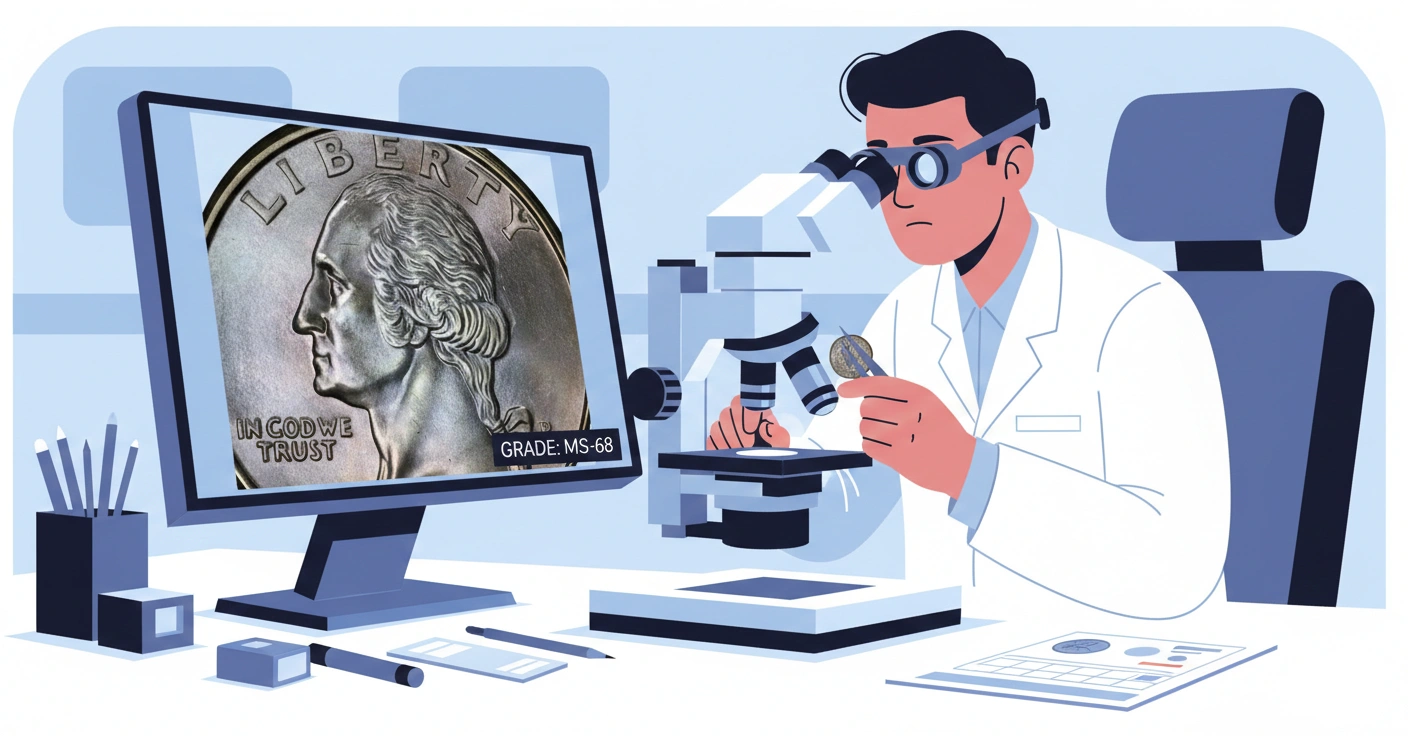
1997-D MS68 (PCGS): Sold for $1,140. This specimen represents the numerical peak for the Denver Mint.
1997-P MS67+ (PCGS): Realized $1,020. The "Plus" designation indicates eye appeal exceeding standard MS67 parameters.
1997-S Silver Proof (PR70DCAM): Averaging $150-$180. Supply remains high, preventing significant price appreciation.
1997-S Clad Proof (PR70DCAM): Trading at $80-$120. Value remains stable with less than 2% annual fluctuation.
Price trends for high-grade clad quarters show a 12% increase in demand when PCGS "Pop" reports show low survival rates for specific dates.
Errors in 1997 are mechanical rather than variety-based, meaning they occur during the striking process.
Strikes missing 10% of the design are common and worth roughly $5.
Pieces missing 50% or more of the design, while retaining the 1997 date, command prices between $150 and $275.
Clipped planchets occurring when the blanking press overlaps previously punched holes sell for $20 to $60.
Wrong metal errors (quarters struck on dime or cent planchets) are not confirmed for 1997, making any such find extremely valuable.
Small "Cud" errors or internal die cracks are frequently found on the eagle's wings.
Values for minor cracks stay under $10, whereas major "Cuds" involving the rim can reach $100.
Coin Type | Grade (PCGS/NGC) | Sale Price | Sale Date |
1997-P | MS67+ | $1,020 | 2021 |
1997-D | MS68 | $1,140 | 2017 |
1997-S Silver | PR70DCAM | $450 | 2012 |
1997-S Clad | PR70DCAM | $150 | 2008 |
Statistics indicate an annual price decline for standard Proof versions, averaging 3% due to the oversaturation of the market with graded coins.
Prices for rare MS67 Philadelphia states show volatility, occasionally rising by 5% during periods of auction supply shortages.
Analyzing the coin population allows for an assessment of high-grade rarity.
Registering more than 400 examples in MS66 grade, the 1997-P issue is well-represented in the PCGS database.
The count for MS67 grade drops significantly to 120 units.
Only a few confirmed MS67+ specimens exist, representing the highest point of gradation for this mint.
Observing the 1997-D issue, the situation remains identical, although the MS67 count exceeds 150 units.
Containing 0.1808 troy ounces of pure silver, the 1997-S Silver Proof quarter is a commodity-linked asset.
Coin prices remain strictly tied to global precious metal market quotes.
When the silver price increases by 10%, the market price of an ungraded 1997-S coin rises by approximately 8.5%.
The premium for numismatic value remains minimal in this case, accounting for roughly 15% over the metal's melt value.
The 1997 quarter remains an accessible object for studying the transitional period of American coinage.
Lacking major varieties, this year offers price stability for novice researchers.
Investment interest remains concentrated exclusively in the segment of high-quality specimens having passed certification in leading grading services.